

Would you bet your company's stability on a misunderstanding of the 5% de minimis threshold? In my journey leading AccouConsult, I've seen even the most established firms in Dubai stumble over the nuances of corporate tax in uae, often underestimating how quickly a simple registration delay turns into a fixed 10,000 AED penalty. The complexity of Free Zone versus Mainland regulations isn't just an administrative hurdle; it's a strategic risk that demands absolute precision and a proactive stance.
You likely recognize that staying compliant while protecting your bottom line is an increasingly delicate balancing act. I understand the frustration of deciphering deductible expenses and the genuine fear of rigorous Federal Tax Authority audits. This guide provides the professional authority you need to master these mandates, ensuring your business remains compliant while legally optimizing its financial position. We'll explore the 2026 landscape, from the Small Business Relief extension for revenues under 3 million AED to the newly available R&D tax credits, providing a definitive roadmap for your registration and filing success.
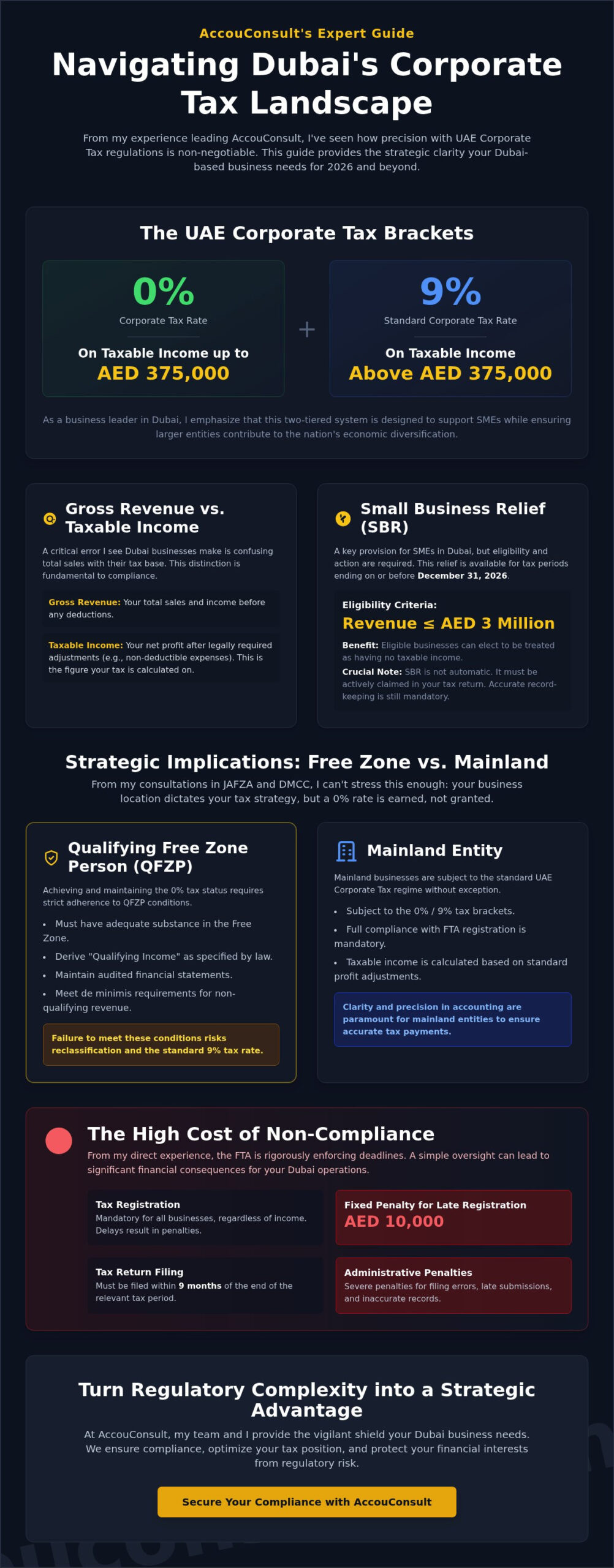
I've spent years advising businesses in Dubai, and I've seen a fundamental shift in how leadership teams view their fiscal responsibilities. Corporate tax in uae is no longer a distant regulatory concept; it's a federal levy on the net profits of businesses that demands absolute precision. This tax isn't a flat fee on revenue. It's a sophisticated system where a 0% rate applies to taxable income up to AED 375,000, while a 9% standard rate is triggered for any income exceeding that threshold. This structure reflects a balanced approach, protecting smaller enterprises while ensuring larger entities contribute to the nation's growth.
The Federal Tax Authority (FTA) acts as the primary regulatory body overseeing this regime. During my journey with AccouConsult, I've witnessed firsthand how the FTA has matured its enforcement capabilities. They aren't just looking for registration; they're auditing for accuracy. This transition marks the UAE's evolution into a global-standard financial hub. You can find more context on the broader fiscal environment in this UAE Taxation Overview, which details how corporate tax interacts with other levies like VAT.
The decision to implement this regime wasn't arbitrary. It's a strategic move to align with the OECD Pillar Two framework and global transparency standards. By diversifying national revenue away from oil dependency, the government is building a more resilient economy. This move strengthens Dubai's position as a premier global business destination. It sends a clear message to international investors: we are a transparent, regulated, and stable environment for long-term growth. As tax standards evolve globally, staying updated with insights from experts like Davis & Co LLP on upcoming 2026 compliance shifts in other key jurisdictions is a prudent strategy for any international operation.
We've moved past the initial grace periods of the 2023 rollout. For 2026, the focus has shifted from preparation to active compliance. Every licensed business must understand its specific Tax Period. If you're a new entity established in Dubai recently, your first filing deadline is a non-negotiable milestone. I've encountered many clients who thought they could wait until the end of the year to start their books. That's a high-stakes gamble. The 2026 landscape for corporate tax in uae requires a proactive partnership with expert tax consultants to avoid the heavy penalties now being enforced by the FTA.
Profit is not the same as taxable income. Understanding this distinction is the first step toward financial security for any business in Dubai. Gross revenue represents your total sales, but taxable income is your net profit after specific accounting adjustments required by law. In my professional journey at AccouConsult, I've seen many entrepreneurs mistake their bank balance for their tax base. This error leads directly to compliance failures. The AED 375,000 threshold exists as a protective measure for SMEs. It ensures that the 9% rate for corporate tax in uae only applies to those with substantial profits. Even if your income falls below this, filing remains mandatory. You must register and submit a return. Silence is not a strategy; it's a trigger for penalties. For precise guidance, checking the Official UAE Corporate Tax Information is essential for every business owner.
Small Business Relief (SBR) is a powerful tool for resident persons with revenue up to AED 3 million. For tax periods ending on or before December 31, 2026, eligible businesses can elect to be treated as having no taxable income. This relief isn't automatic. You must actively claim it. In my experience, businesses hovering around that AED 3 million mark face the most risk. You need a clear strategy to manage growth without accidentally triggering a higher tax bracket. Record-keeping remains a legal requirement regardless of relief status. You still need robust Accounting Services to prove your eligibility if the FTA requests documentation.
Calculating your tax base requires more than just looking at your P&L statement. Standard adjustments include non-deductible expenses like 50% of entertainment costs and specific interest deduction limitations. Permanent establishments also face unique rules regarding profit attribution. Taxable Income is the accounting profit adjusted for specific tax-law provisions. Managing these adjustments requires a level of precision that general accounting often misses. Don't let a simple math error compromise your standing in the Dubai market. I've guided dozens of firms through these calculations to ensure they only pay what is legally required, protecting their capital for future expansion.
The 0% rate is not a default setting for Dubai Free Zone entities; it is a hard-earned status. Many business owners I meet in zones like JAFZA or DMCC mistakenly believe their location grants them an automatic exemption from corporate tax in uae. This is a dangerous assumption. The reality is a strict 0% versus 9% dichotomy. To secure that zero-rate, you must meet the rigid criteria of a Qualifying Free Zone Person (QFZP). If you engage in non-qualifying activities or fail to maintain adequate substance, you risk tainting your entire income stream. This potentially exposes every dirham of profit to the standard 9% rate. This isn't just a clerical error. It's a strategic failure that can erode years of fiscal planning. For a comprehensive breakdown of these requirements, our definitive guide on corporate tax for free zone companies in the UAE covers every qualifying criterion in detail.
I've seen firsthand how a single mainland contract, if not structured correctly, can jeopardize a Free Zone entity's tax standing. The UAE Federal Tax Authority has clear guidelines on what constitutes qualifying income, yet the lines often blur for businesses with mainland branches. This cross-jurisdictional complexity requires a vigilant eye and proactive management. It ensures your corporate structure remains a shield rather than a liability. At AccouConsult, we emphasize that ignoring these nuances isn't an option for those seeking long-term stability in the Dubai market.
Substance is the cornerstone of your 0% claim. You must demonstrate that your core income-generating activities happen within the zone. This involves having adequate staff, assets, and operating expenditure on the ground. Beyond substance, audited financial statements are a non-negotiable requirement. Without an audit, the 0% rate is off the table. You must also respect the De Minimis rule for non-qualifying revenue. This threshold is set at the lower of 5% of your total revenue or AED 5 million. Exceeding this even by a fraction triggers the 9% rate on all non-qualifying income. It makes precise record-keeping and professional accounting essential for survival.
Your initial business setup decisions now carry heavy tax consequences. In some cases, I've advised clients that converting to a Mainland entity is actually tax-neutral or even beneficial when you factor in the operational freedom it provides. The choice depends on your specific market reach and activity type. Navigating these waters shouldn't be done alone. Expert Tax Consultancy is no longer an optional luxury; it's a prerequisite for anyone running a multi-jurisdictional operation in Dubai. We help you weigh the benefits of Free Zone status against the compliance costs. This ensures your path is the most efficient one available for your unique journey.
Compliance isn't a suggestion; it's the foundation of your business's survival in Dubai. I've guided numerous firms through the EmaraTax portal, and the process, while structured, leaves no room for error. To secure your standing, you must follow a precise 5-step registration protocol. It begins with creating or logging into your EmaraTax account and selecting the corporate tax in uae registration service. From there, you must meticulously complete the application with your entity details, upload essential documents including your Trade License and Memorandum of Association (MOA), and submit for final FTA review. Any discrepancy in these documents can lead to immediate rejection or, worse, a compliance red flag.
Once registered, the clock starts ticking on your filing obligations. The UAE regime mandates a strict nine-month window for filing tax returns and making payments after the end of the relevant tax period. This isn't a generous grace period; it's a deadline that requires months of preparation. In my experience at AccouConsult, businesses that wait until the eighth month often find themselves in a chaotic scramble to reconcile their books. Don't let your business fall into this trap. A fixed penalty of AED 10,000 is imposed for late registration for corporate tax, a cost that is entirely avoidable with proactive management. Working with a qualified corporate tax consultant from the outset ensures your registration timeline is managed with precision and your filing obligations are never left to chance.
The 2026 timeline for registration is often tied to the month your trade license was originally issued. Waiting until the final weeks of your assigned window is a tactical error. System delays or document requests from the FTA can easily push you past the cutoff. The Federal Tax Authority imposes a fixed penalty of AED 10,000 for any business that fails to submit its registration application within the timelines prescribed by the law.
Your first return is a high-stakes document. It requires tax-ready financial statements that align with the adjustments we discussed earlier. You must also ensure that all inter-company transactions adhere to "Arm's Length" principles to satisfy transfer pricing requirements. Finally, a rigorous validation of deductible versus non-deductible expenses is essential to avoid overpaying or triggering an audit. To ensure your filing is bulletproof, contact our team for expert Tax Consultancy today.
The regulatory environment in Dubai has reached a level of sophistication where "doing it yourself" is no longer a viable business strategy. I've spent my career building AccouConsult to serve as a vigilant guide for companies facing the complexities of corporate tax in uae. My professional journey, led by a commitment to precision, has shown me that accidental non-compliance is the single greatest threat to a firm's longevity. It isn't just about avoiding the 10,000 AED registration penalty; it's about building a financial structure that is resilient, transparent, and optimized for long-term growth.
Accidental errors in expense classification or transfer pricing documentation can trigger audits that drain both time and capital. We mitigate these risks by providing a protective layer of expertise. One of the most effective ways we achieve this is through Erp implementation. By automating your tax data collection, we eliminate the manual errors that often lead to FTA scrutiny. This ensures your data is tax-ready long before the nine-month filing window approaches. We don't just react to the law; we prepare your infrastructure to handle it with ease.
Our method is comprehensive. We provide end-to-end support that begins with accurate registration and concludes with a flawless final filing. We don't look at corporate tax in uae in isolation. We integrate our VAT consultancy with your tax strategy to ensure holistic compliance across all federal levies. This proactive approach allows us to identify legal tax-saving opportunities, such as the R&D credits or Small Business Relief, that most generalist firms overlook. We act as a strategic ally, simplifying the complex so you can focus on your core operations.
This focus on core operations is essential for long-term success; for instance, the advisory model used by Venta Belgarum shows how prioritizing profitability and personal freedom can lead to more sustainable growth across any market.
True stability comes from having data you can trust. Our Accounting Services are designed to provide the granular detail required for sophisticated tax optimization. For businesses navigating the rapid market changes of 2026, our Outsourced CFO advisory offers a seasoned perspective on capital allocation and fiscal health. It's time to move from a defensive posture to one of strategic advantage. Contact AccouConsult for a comprehensive tax health check to ensure your business is fully prepared for the year ahead and beyond.
Mastering the complexities of corporate tax in uae is no longer just a compliance task; it's a fundamental pillar of your business strategy in Dubai. We've explored the critical importance of maintaining Qualifying Free Zone status and the precision required to navigate the 9% threshold. My journey with AccouConsult has taught me that the difference between a thriving enterprise and one burdened by FTA penalties lies in proactive, expert-led management. You don't have to face these regulatory shifts alone.
Our team provides the unwavering reliability you need through expert ERP implementation for tax automation and specialized VAT and Corporate Tax advisory. Whether you require end-to-end business setup support or robust accounting services, we act as your vigilant guide in this high-risk environment. It's time to transform tax compliance from a source of concern into a structured roadmap for excellence. Protect your business with professional UAE Tax Consultancy and ensure your financial health remains unshakeable. Your future in the Dubai market is bright when backed by the right expertise.
Yes, registration for corporate tax in uae is a mandatory requirement for all taxable persons, including those operating within Dubai Free Zones. Even if your business generates zero income or qualifies for an exemption, you must obtain a Tax Registration Number (TRN) through the EmaraTax portal. I've seen many Mainland startups ignore this step, only to face immediate administrative hurdles when trying to renew their licenses or open corporate bank accounts.
A Free Zone entity can benefit from a 0% rate in 2026 provided it maintains its status as a Qualifying Free Zone Person (QFZP). This requires maintaining adequate substance in Dubai and ensuring non-qualifying revenue stays below the de minimis threshold of 5% of total revenue or AED 5 million. My team at AccouConsult frequently audits these conditions to prevent our clients from accidentally triggering the standard 9% rate on their entire profit pool. Understanding the full scope of these obligations is critical, and our 2026 reference guide on corporate tax for free zone companies in the UAE provides the complete framework for maintaining compliant QFZP status.
The Federal Tax Authority (FTA) imposes a fixed administrative penalty of AED 10,000 for the late registration of corporate tax. This fine applies the moment your specific registration deadline, which is typically determined by your license issuance month, passes without a submitted application. In my professional experience, these penalties are issued swiftly, making it vital to verify your deadline before the FTA intervenes.
The 9% tax does not apply to an individual's salary, wages, or employment income earned in the private or public sector. However, if you're a natural person conducting business in Dubai with an annual turnover exceeding AED 1 million, your business income will fall under the corporate tax regime. This is a distinction that often confuses freelancers, which is why we provide specialized Tax Consultancy to clarify these specific boundaries.
To qualify for Small Business Relief in 2026, a resident person's revenue must not exceed AED 3 million for the relevant tax period. You must actively elect for this relief within your tax return; it is never granted by default. I always advise my clients that while SBR treats taxable income as zero, it doesn't waive the legal requirement for meticulous record-keeping or registration with the FTA.
You're required to file a corporate tax return once for each tax period, which usually aligns with your financial year. The submission and any associated tax payments must be completed within nine months from the end of that period. This annual cycle demands a disciplined approach to your Accounting Services to ensure your financial data is validated and ready for the portal well before the deadline.
Foreign entities are subject to corporate tax in uae if they have a permanent establishment in the country or derive income from a UAE nexus. This includes foreign companies that are effectively managed and controlled from an office in Dubai. We often assist international firms in determining their tax residency status to ensure they meet their local obligations without risking double taxation or non-compliance penalties.
Several costs are strictly non-deductible, including administrative penalties, bribes, and recoverable VAT. Only 50% of entertainment expenditure for customers, shareholders, or suppliers can be deducted from your taxable profit. I've helped many Dubai businesses recalibrate their internal spending policies to account for these limitations. This ensures their tax calculations remain bulletproof during potential audits.

AccouConsult is an accounting firm who helps its clients through audit & assurance, tax advisory, technology advisory, and risk advisory services.
Quick Links
Contact us
© 2025 AccouConsult. All Rights Reserved.
Designed & Developed By 10X Digital
