Free Zone vs Mainland Company in the UAE: The Strategic Comparison
Choosing between a free zone vs mainland company uae used to be a simple decision about ownership, but in 2026, the strategy has shifted entirely toward tax optimization and jurisdictional compliance. You're likely concerned that the 9% Corporate Tax and evolving trade restrictions in Dubai could erode your margins if your corporate structure isn't perfectly aligned with current FTA regulations. At AccouConsult, we understand that this uncertainty is more than a hurdle; it's a direct threat to your operational efficiency. You deserve a setup that offers both the freedom to trade and the security of a robust tax shield.
This guide provides the definitive strategic roadmap to help you navigate these complexities with the confidence of a market leader. AccouConsult will break down the specific nuances of the "Invest in Dubai" portal requirements, the 100% foreign ownership exceptions in strategic sectors, and the exact criteria for maintaining a 0% tax rate as a Qualifying Free Zone Person. We'll move beyond generic advice to deliver a precise decision matrix for your industry. You'll gain the compliance certainty needed to optimize your costs and protect your interests in an increasingly sophisticated UAE business environment.
Key Takeaways
- AccouConsult clarifies the fundamental structural shifts between Dubai Department of Economy and Tourism (DET) licenses and free zone entities in the 2026 landscape.
- Determine your optimal geographic trading reach to ensure your business can legally execute contracts and deliver services across specific Emirates without restriction.
- Navigate the intersection of VAT and the 9% Corporate Tax to secure your status as a Qualifying Free Zone Person or prepare your mainland entity for compliance.
- Utilize AccouConsult’s industry-specific framework to decide if a free zone vs mainland company uae structure provides the necessary prestige for your service-based goals.
The 2026 UAE Business Landscape: Defining Mainland and Free Zone Entities
AccouConsult views the 2026 regulatory environment as a mature ecosystem where the lines between jurisdictions have blurred, yet the legal consequences remain distinct. The fundamental debate of free zone vs mainland company uae has evolved. It's no longer just about who owns the shares. Following the sweeping amendments in Federal Decree-Law No. 26 of 2020, the historic requirement for a local Emirati partner holding 51% of shares has largely vanished for most commercial activities. This shift has unified the playing field for international investors, making the choice of structure a purely strategic decision based on market access and tax positioning.
What is a UAE Mainland Company?
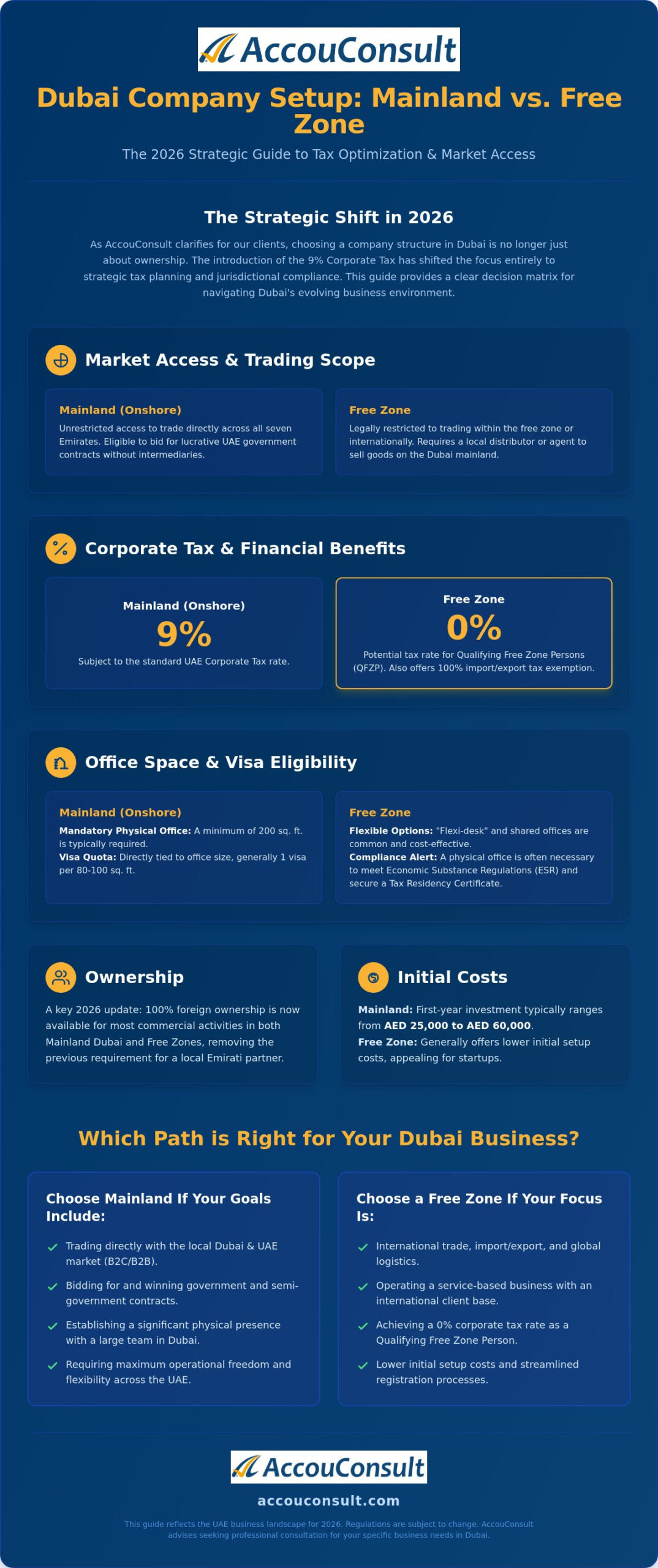
AccouConsult defines a Mainland entity as an onshore company licensed by the Department of Economy and Tourism (DET) in Dubai or its equivalent in other Emirates. These companies are governed directly by the UAE Ministry of Economy and operate under the federal legal framework. Mainland entities serve as the primary vehicle for local market penetration, allowing you to trade directly with the public and bid for lucrative government contracts without geographic restrictions. While the base license fee via the "Invest in Dubai" portal is AED 1,070, the total first-year investment typically ranges from AED 25,000 to AED 60,000 depending on your office requirements and visa needs. You'll have the freedom to operate across all seven Emirates without the need for a local agent, provided you aren't in a "strategic impact" sector like defense or banking.
Understanding the UAE Free Zone Model
Free Zones are specialized economic hubs that function as independent jurisdictions with their own regulatory authorities. These areas are often classified as "designated zones" for VAT purposes, offering a ring-fenced environment for specific industries. Whether you're looking at tech-heavy zones or logistics centers, the variety is vast. You can explore a comprehensive list of UAE Free Trade Zones to see how these hubs cater to niche markets. These zones offer 100% import and export tax exemptions, making them ideal for companies focused on international trade. However, they don't have the legal permit to trade directly on the Dubai mainland without a local distributor, a limitation that AccouConsult helps clients weigh against the lower initial setup costs. The distinction between a generalist zone and a sector-specific one is critical; choosing the wrong hub can limit your access to industry-specific infrastructure and networking pools.
Key Operational Differences: Scope, Visas, and Infrastructure
AccouConsult analyzes the operational constraints that dictate your daily business efficiency. The decision between a free zone vs mainland company uae isn't merely a legal formality; it's a choice that defines your company's physical footprint and its ability to attract talent. While both structures offer 100% foreign ownership in 2026, the ceiling for your expansion is often determined by the specific Emirate where you choose to plant your roots. In Dubai, for instance, the infrastructure you select today will govern your ability to sign contracts tomorrow.
Trading Restrictions and Market Access
A Mainland license provides you with unrestricted access to the entire UAE market. You can bid for lucrative government contracts and sell directly to the local B2C market without a middleman. Free Zone companies face a different reality. If your entity is based in a specialized hub, you're legally restricted to trading within that zone or internationally. To sell goods in the Dubai mainland, you'll need to appoint a local distributor or agent, which adds a layer of cost and complexity to your supply chain. Alternatively, you can establish a Mainland branch of your Free Zone company, a strategy AccouConsult often recommends for businesses ready to bridge the gap between global trade and local retail.
Office Requirements and Visa Eligibility
Your ability to hire talent is inextricably linked to your physical office space. In the Dubai Mainland, a physical office of at least 200 square feet is generally mandatory. This space isn't just for show; it determines your visa quota. Typically, you're granted one visa for every 80 to 100 square feet of leased space. If you plan on scaling a large team, you'll need the square footage to support it.
Free Zones often lure investors with "Flexi-desk" options. While these are cost-effective, they come with significant 2026 compliance caveats. For many high-turnover businesses, a Flexi-desk may no longer suffice for tax residency purposes or Economic Substance Regulations (ESR). If you need a Tax Residency Certificate to benefit from double taxation treaties, a physical office is often the only way to prove your "center of vital interests" is in the UAE. Understanding these nuances is vital before you commit to a structure. You can find more detail in The Comprehensive Guide to the Cost of Business Setup in UAE (2026).
Choosing the right infrastructure requires a vigilant guide to ensure your setup remains compliant as your head count grows. If you're unsure which path secures your operational future, AccouConsult provides the Business setup expertise needed to align your physical presence with your commercial goals.
Tax Implications and Regulatory Compliance in 2026
AccouConsult clarifies the complex intersection of Corporate Tax and VAT for both structures. The fiscal landscape of the UAE has undergone a paradigm shift, moving from a tax-free haven to a sophisticated, regulated jurisdiction. Understanding the nuances of a free zone vs mainland company uae is now primarily an exercise in tax engineering. In 2026, the Federal Tax Authority (FTA) has intensified its focus on substance and transparency, meaning your corporate structure must do more than just exist; it must comply with rigorous federal standards.
Corporate Tax: Mainland vs. Free Zone Nuances
Mainland companies operate under a clear mandate: a 0% tax rate applies only to taxable income up to AED 375,000. Any profit exceeding this threshold is subject to the standard 9% Corporate Tax rate. This makes precise accounting non-negotiable for Dubai-based onshore entities. Conversely, Free Zone entities may still benefit from a 0% rate, but only if they meet the strict criteria of a "Qualifying Free Zone Person" (QFZP). This status requires maintaining adequate substance in the UAE and ensuring that "Qualifying Income" does not include earnings from excluded activities or transactions with Mainland individuals. You can explore these requirements in detail through our guide on Mastering Corporate Tax in the UAE: A Strategic Guide for 2026. Failure to meet these QFZP benchmarks results in the entire profit being taxed at the 9% rate, effectively removing the Free Zone's primary fiscal advantage.
VAT Compliance and Financial Reporting
VAT registration requirements apply equally across both structures once the mandatory threshold is met. While "Designated Zones" offer specific VAT exemptions for goods transferred between zones, services provided within these areas are generally subject to the standard 5% rate. AccouConsult emphasizes that 2026 regulations now require audited financial statements for most Free Zone license renewals, a move designed to align with international reporting standards. This evolution makes professional accounting and bookkeeping services in dubai an essential component of your operational strategy rather than a back-office afterthought. Compliance is no longer optional. It's the price of entry for the UAE market.
Protecting your business from administrative penalties requires a proactive partnership with experts who understand the local regulatory pulse. Secure your financial integrity with our specialized Tax Consultancy services to ensure every dirham is accounted for under the latest FTA mandates.
Industry-Specific Decision Framework: Which Structure Fits Your Goal?
AccouConsult provides a tailored approach based on your primary business activity. Your industry dictates your jurisdiction. The debate of free zone vs mainland company uae isn't a one-size-fits-all scenario; it's a strategic calculation of market access versus operational isolation. Service-based businesses often find that a Dubai Department of Economy and Tourism (DET) license offers superior credibility and prestige. Don't be misled by the perceived ease of Free Zones. A Mainland setup allows you to bid for government contracts and serve local conglomerates across Dubai without administrative friction, providing a strategic advantage for entities like Anas Visual that require unrestricted access to clients. While a Free Zone might offer sector-specific networking, it legally restricts your physical service delivery to that specific zone.
For those looking to establish a community marketplace for home services or artisanal products, you can check out TalentHome UAE as a prime example of a platform that prioritizes direct connection with residents across the Emirates.
E-commerce and retail entities must prioritize logistics and customs efficiency. Delivering goods directly to Dubai residents requires a Mainland structure to avoid the customs duties and agent fees associated with Free Zone transfers. International traders, however, should leverage the infrastructure of specialized hubs. These zones are optimized for the global movement of goods, offering 100% import and export tax exemptions that protect your international margins. AccouConsult ensures your choice reflects these logistical realities to prevent future operational bottlenecks.
The Dubai Advantage: Regional Nuances in Business Setup
Dubai offers a spectrum of choices, from the commodities-focused DMCC to the tech-driven Dubai Development Authority (DDA). Each jurisdiction has its own regulatory pulse. A DET license in Mainland Dubai provides the ultimate flexibility for regional expansion and remains the gold standard for regional credibility. You must choose a location that aligns with your target client base. Don't establish a consultancy in a remote logistics hub if your primary clients are located in Dubai's central business districts. AccouConsult helps you navigate these micro-market nuances to ensure your physical address supports your commercial growth.
AccouConsult’s Strategic Recommendation
AccouConsult advocates for a rigorous cost-benefit analysis before you commit to any lease. This analysis must include projecting long-term tax liabilities under the 2026 9% Corporate Tax regime and assessing the physical office requirements for your visa needs. Our expert consultants manage the end-to-end setup process, acting as your vigilant guide through the complexities of the "Invest in Dubai" portal and Free Zone authority requirements. We don't just set up companies; we build compliant, tax-efficient structures that protect your interests.
Final checklist: 5 questions to ask before signing your lease agreement:
-
Does your activity require direct sales to the local Dubai public?
-
Will you bid for government-linked or semi-government contracts?
-
How many employees do you need to house to meet your visa quota?
-
Is your primary revenue coming from international trade or local services?
-
Does your chosen zone provide the specific industry-specific infrastructure you demand?
Success in the UAE market requires more than just a license. It requires a partner who understands the local regulatory landscape. Ensure your future is secure by engaging AccouConsult for your Business setup and Tax Consultancy needs today.
Securing Your Strategic Advantage in the 2026 UAE Market
The choice between a free zone vs mainland company uae has moved beyond simple ownership percentages to a complex evaluation of tax residency and local market access. AccouConsult has demonstrated that while 100% foreign ownership is now the standard, the 9% Corporate Tax and evolving FTA regulations require a precise jurisdictional fit. Your decision today dictates your ability to scale across Dubai and beyond without facing unforeseen administrative hurdles or fiscal penalties. Whether you seek the international trade benefits of a specialized hub or the unrestricted reach of a Mainland license, your structure must support rigorous compliance standards.
Don't leave your corporate stability to chance in an increasingly regulated environment. AccouConsult offers the expert VAT and Corporate Tax advisory needed to navigate these fiscal shifts with confidence. From end-to-end business setup support to strategic ERP implementation for scaling firms, we act as your vigilant guide and protective ally. Secure your UAE business future with a professional consultation from AccouConsult to ensure your operations are built on a foundation of reliability and excellence. Your path to sustainable growth in Dubai starts with a partner who prioritizes your long-term success.
Frequently Asked Questions
Can a Free Zone company trade with a Mainland company in the UAE?
A Free Zone company can trade with Mainland entities, but they typically require a local distributor or an agent to sell physical goods within the local market. AccouConsult notes that for services, while you can sign contracts with Mainland firms, your physical operations must remain within the zone or be conducted internationally. Attempting to trade directly on the Dubai Mainland without the correct legal framework can lead to significant administrative penalties.
Is 100% foreign ownership available for Mainland companies in 2026?
AccouConsult confirms that 100% foreign ownership is widely available for Mainland companies in 2026 across most commercial and industrial activities. This follows the landmark amendments in Federal Decree-Law No. 26 of 2020. However, strategic impact sectors such as security, defense, banking, and telecommunications still require a level of local Emirati ownership to ensure national stability and regulatory oversight.
Do Free Zone companies have to pay the 9% UAE Corporate Tax?
Free Zone entities are subject to the 9% Corporate Tax unless they meet the rigorous standards of a Qualifying Free Zone Person. To maintain a 0% rate, your company must maintain adequate substance in the UAE and generate qualifying income as defined by the FTA. When comparing a free zone vs mainland company uae, AccouConsult emphasizes that failing to meet these criteria results in the standard 9% tax on all taxable income exceeding AED 375,000.
What are the main differences in visa costs between Mainland and Free Zones?
Mainland visa costs are intrinsically linked to your physical office space, whereas Free Zone visas are often more flexible and cost-effective for small teams. In Dubai Mainland, your visa quota is determined by the square footage of your office, typically requiring 80 to 100 square feet per visa. Free Zones offer visa packages that don't always require large physical premises, though AccouConsult warns that this may impact your ability to prove tax residency in 2026.
Can I switch my business from a Free Zone to a Mainland license later?
You cannot technically switch or convert a license directly from a Free Zone to the Mainland. Instead, AccouConsult recommends either establishing a Mainland branch of your existing Free Zone entity or incorporating a fresh Mainland company. This process involves a new registration with the Dubai Department of Economy and Tourism (DET) and a separate set of operational permits to ensure full legal compliance across the Emirates.
Which Emirate is best for setting up a Mainland company in 2026?
Dubai remains the most strategic Emirate for Mainland setups in 2026 due to its sophisticated "Invest in Dubai" digital infrastructure and robust economic growth projections. The Emirate's proactive stimulus packages and status as a top destination for foreign investment provide a level of security and prestige that is difficult to match. AccouConsult evaluates your specific industry to ensure your chosen location aligns with your primary client base and operational logistics.
Leave a Reply