

What if your tax exemption status is actually the very thing that triggers a Federal Tax Authority audit in 2026? We have met numerous founders in Dubai who assumed their 0% rate meant they could safely ignore the registration portal. This is a dangerous fallacy. With over 651,000 corporate tax registrants now on the books, the FTA is intensifying its risk-based audits, specifically targeting those who claim relief without maintaining the required "adequate substance." We have seen firsthand how the complex language of the Corporate Tax Law creates unnecessary fear, but silence is often interpreted as non-compliance by the authorities.
The distinction between Free Zone and Mainland obligations feels more volatile than ever. This guide promises to uncover the reality behind UAE tax exemptions and provide you with a clear roadmap to maintain compliance without falling into common regulatory traps. We'll explore the specific de minimis thresholds, the Small Business Relief election, and the exact steps at AccouConsult to ensure our clients avoid the AED 10,000 late registration penalty.
A tax exemption is not a free pass to disappear from the regulatory radar. It is a specific, legally defined status under the Corporate Tax Law that requires rigorous substantiation to maintain. Many business owners in Dubai mistakenly believe that being exempt makes them invisible to the Federal Tax Authority (FTA). At AccouConsult, we reject this passive approach. We advocate for proactive compliance because the history of Taxation in the United Arab Emirates shows a rapid shift toward transparency and digital oversight. We have observed that Dubai's regulatory environment evolves at a pace that often leaves stagnant businesses exposed. If you aren't actively proving your status, the FTA may eventually assume it doesn't exist.
Believing you don't need to register because you don't owe tax is a costly error. Most entities qualifying for a tax exemption must still obtain a Tax Registration Number (TRN). Failing to do so before the specified deadlines results in a fixed AED 10,000 penalty. In my experience with recent enforcement trends, the FTA is no longer issuing gentle reminders. They're using automated systems to identify unregistered entities across the Emirates. Registration is the first line of defense in protecting your corporate standing. It's a mandatory administrative step, regardless of your final tax bill.
The blanket assumption that every Free Zone entity is exempt is perhaps the most dangerous myth in the market. There's a critical distinction between a standard Free Zone company and a Qualifying Free Zone Person (QFZP). To secure the 0% rate, your Dubai-based business must pass complex "Qualifying Income" tests and meet strict de minimis requirements. We often utilize our VAT consultancy expertise to verify if cross-border transactions inadvertently disqualify a client from their preferred status. Without this level of scrutiny, you risk being taxed at the standard 9% rate on all income. Don't assume your license location guarantees your tax rate.
Identifying your eligibility for a tax exemption requires a departure from guesswork. The UAE Corporate Tax Law provides a rigid framework, yet many businesses struggle to interpret where they land. At AccouConsult, we treat this assessment as a forensic exercise. We don't just look at what you do; we look at how the law classifies your specific entity type. This is particularly relevant for the large-scale infrastructure projects that define the modern landscape of the Emirates, where the lines between government-linked activity and commercial enterprise can blur.
Government Entities and Government Controlled Entities are the bedrock of the "automatically exempt" category. However, "controlled" doesn't mean "unlimited." These subsidiaries must focus on their mandated public activities. If they drift into purely commercial competition, that status is jeopardized. At AccouConsult, we maintain high ethical standards when assessing eligibility for extractive exemptions. We ensure that our clients in the natural resource sector are fully compliant with the specific Emirates-level agreements that often govern these operations.
The following categories require a more proactive approach:
Qualifying Public Benefit Entities (QPBE) serve the social fabric of Dubai. Think of charities, research institutes, or social welfare organizations. To maintain a tax exemption, these entities must be explicitly listed in a Cabinet Decision. Being "good" isn't enough; you must be recognized. My advice to QPBE directors is simple: prepare for rigorous audits. The FTA expects these organizations to demonstrate that every dirham serves the public interest. If you're unsure where your organization stands, a professional Tax Consultancy review can provide the clarity you need. We act as your vigilant guide, ensuring your social mission isn't derailed by administrative oversights.
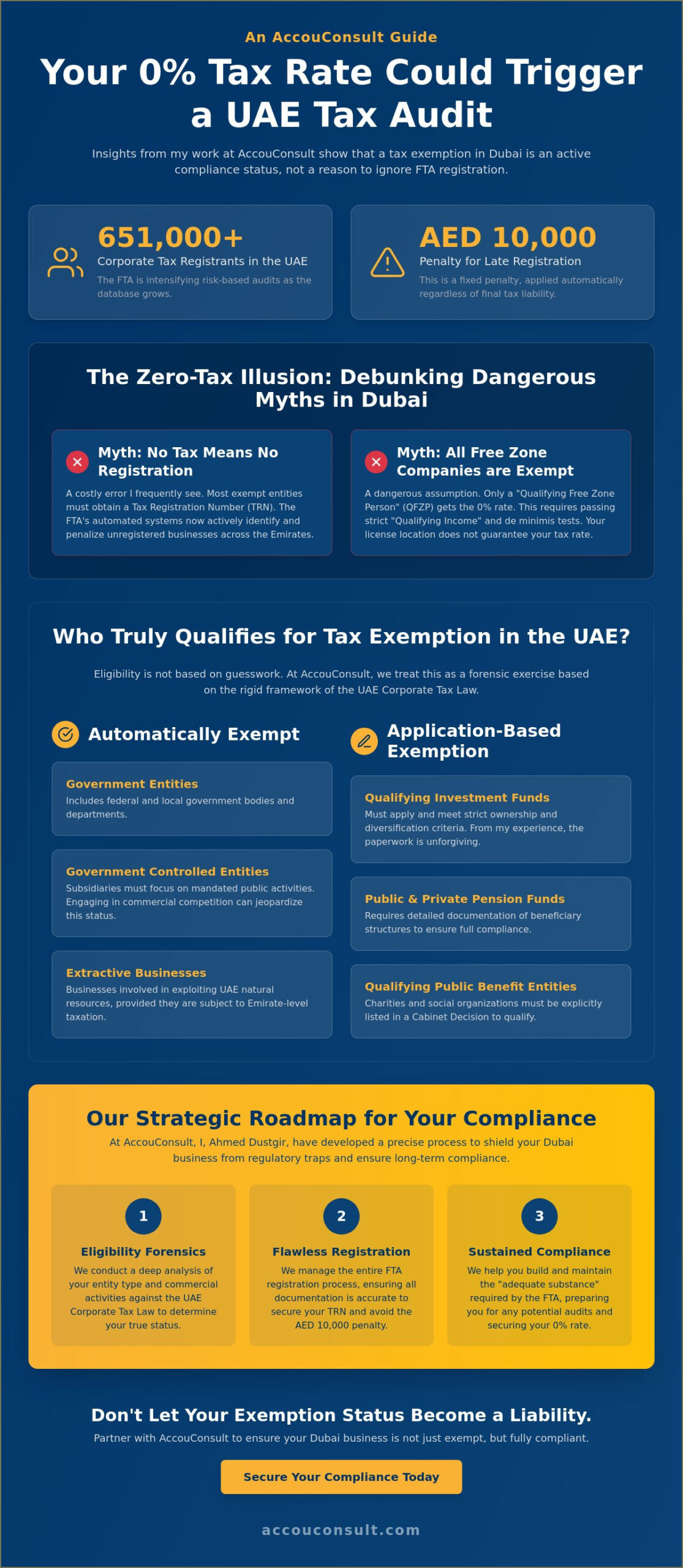
Many directors we consult in Dubai fall into a common trap. They assume that because they qualify for a tax exemption, they don't need to engage with the tax system at all. This is a fallacy that leads directly to administrative penalties. To protect your interests, you must register on the EmaraTax portal managed by the Federal Tax Authority (FTA). At AccouConsult, we emphasize a no-nonsense approach to these requirements. You can't afford to wait for a notification that may never come before the fines do. Silence from the authority isn't an endorsement of your status.
Maintaining this status requires precise tracking of your income streams. We often recommend an integrated ERP implementation to our clients to ensure that exempt activities are clearly segregated from any taxable commercial ventures. This level of technical oversight is essential for long-term stability and audit defense. For a deeper dive into the broader regulatory framework and how it affects your specific sector, you should review our guide on Mastering Corporate Tax in the UAE. We build these roadmaps to ensure no detail is overlooked.
The 2026 regulatory calendar is strict. For example, natural persons with a business turnover exceeding AED 1 million in 2025 must complete their registration by March 31, 2026. If you incorporated a new company on or after March 1, 2024, you have exactly three months from the date of incorporation to register. To secure your Tax Registration Number (TRN), you'll need your trade license, passport copies of owners, and proof of authorization. The TRN is the cornerstone of UAE tax identity for every corporation. Failing to secure it in time results in a fixed AED 10,000 penalty.
Registration is only the beginning. Even if you represent an exempt person, you may still be required to file annual tax returns to confirm your continued eligibility. UAE law mandates a 7-year record-keeping rule for all financial transactions. Many businesses struggle during audits because they lack documentation from five years prior. To manage these high-level compliance tasks, many of our partners utilize our CFO Advisory Services in Dubai. This ensures that your records are not just kept, but are audit-ready at all times. If you're concerned about your current registration status, contact us for a professional Tax Consultancy session today.
The complexity of the UAE tax regime demands more than a casual glance at a government portal. Securing a tax exemption is a strategic achievement; it's not an administrative coincidence. At AccouConsult, we act as the vigilant guide your business requires to navigate these high-stakes waters. We have built this firm on the principle that our clients deserve unwavering reliability and data-driven financial insights. We don't just process papers. We guard your interests by simplifying the end-to-end journey of business setup and tax registration in Dubai, ensuring your foundation is built on compliance from day one.
Attempting to manage your tax strategy without expert oversight is a gamble with your company's future. The Federal Tax Authority (FTA) frequently issues public clarifications that require sophisticated interpretation. Misreading a single clause can result in the immediate loss of your exempt status. The cost-benefit analysis is clear. Investing in professional tax consultancy far outweighs the financial drain of paying a 14% per annum late payment penalty or a 9% tax rate on income you thought was exempt. For small business owners with international interests, firms like ASAP Solutions offer similar high-level guidance to navigate 2026 compliance. At AccouConsult, we provide assertive protection during FTA tax audits and ensure your records stand up to the most rigorous scrutiny.
Our proactive partnership model is designed for corporate leaders who value precision. We move quickly to identify potential hesitations and replace them with a comprehensive sense of security. Your business in Dubai needs a strategic ally that speaks with authority and understands the localized nuances of the Emirates. Don't leave your compliance to chance. We invite you to secure your business future through a strategic consultation that prioritizes your unique operational needs. Ensure your tax exemption status is fully compliant with AccouConsult today. We are the stable and protective force your organization needs to thrive in a regulated world.
The 2026 tax landscape requires a shift from passive observation to assertive action. We've established that a tax exemption is a legal status to be defended, not a reason to ignore the Federal Tax Authority. Our experiences in Dubai have proven that the most resilient businesses are those that integrate their accounting systems with robust ERP solutions long before an audit arrives. Don't let administrative deadlines or complex legal language compromise your company's standing in the Emirates.
At AccouConsult, a team dedicated to providing specialized UAE Corporate Tax and VAT consultancy that prioritizes your stability. We offer the precision of comprehensive accounting integration and the seasoned insight of my personal expertise to simplify every regulatory hurdle. It's time to move beyond the zero-tax illusion and build a foundation of unwavering reliability. Secure your business compliance with AccouConsult's expert tax advisory. Your journey toward long-term prosperity in Dubai starts with a strategic decision to prioritize excellence today.
No, the 0% rate is not an automatic right for all Free Zone entities. To qualify for a tax exemption as a Qualifying Free Zone Person, your Dubai business must maintain adequate substance and pass the de minimis threshold. If your non-qualifying revenue exceeds 5% of your total revenue or AED 5,000,000, whichever is lower, you'll be taxed at the standard 9% rate on your taxable income.
Yes, registration is a mandatory legal requirement for the vast majority of exempt entities. You must obtain a Tax Registration Number (TRN) via the EmaraTax portal to formalize your status with the Federal Tax Authority. I've guided many clients through this process at AccouConsult to ensure their exempt status doesn't lead to an unregistered penalty. Registration is the only way the FTA recognizes your legal standing.
Missing the deadline results in an immediate AED 10,000 administrative penalty for late registration. While a waiver exists for businesses that file their first return within seven months of their first tax period end, we strongly advise against this gamble. The FTA is intensifying its enforcement in 2026. Proactive registration is the only way to safeguard your capital and maintain your professional reputation in the Emirates.
Natural persons, such as freelancers or sole proprietors in Dubai, are exempt if their turnover remains at or below AED 1 million. If your turnover exceeds this threshold in 2025, the law requires you to register for corporate tax by March 31, 2026. My team at AccouConsult often performs turnover audits to help individuals determine their exact registration window. We ensure you don't cross these thresholds without a compliance plan.
You must maintain all financial records and supporting documents for a minimum of seven years. These records must clearly substantiate your tax exemption and demonstrate that you meet all qualifying criteria. In Dubai, the FTA expects digital records that are easily accessible during a risk-based audit. We have seen how inadequate documentation can trigger unnecessary tax liabilities, so we prioritize robust record-keeping for all our clients, and you may explore Bookkeeper options to find the virtual support needed to keep your files in order.
Status confirmation typically occurs annually through the filing of a corporate tax return, even if no tax is due. Some entities, like Qualifying Investment Funds, must monitor their eligibility continuously and notify the Ministry of Finance of any changes in their structure. At AccouConsult, we treat status maintenance as an ongoing partnership rather than a one-time event. This vigilant approach ensures your protection remains uninterrupted as regulations evolve.

AccouConsult is an accounting firm who helps its clients through audit & assurance, tax advisory, technology advisory, and risk advisory services.
Quick Links
Contact us
© 2025 AccouConsult. All Rights Reserved.
Designed & Developed By 10X Digital
